Jump to section
Key Takeaways
- Google Ads wins on speed (results within days); SEO wins on long-term ROI (~748% vs. ~36% for PPC) and lead economics (~$31 vs. ~$181 cost per lead; ~14.6% vs. ~1.7% close rate in comparative data).
- Local SEO often lands around ~700% ROI with a 6–12 month payoff window; full SEO take-hold is typically 6–18 months — plan the sequence, not an either/or forever choice.
- Offer clarity and conversion paths must be solid before you scale either channel.
- A practical SMB allocation starts paid-heavy for velocity, then rebalances toward SEO as pipeline and proof stabilize.
- Track channels by contribution (assisted conversions, branded lift, close rate by first touch), and run both as one hybrid revenue engine with shared messaging and conversion standards.
Want help applying this?
Get a clear next-step plan tied to pipeline and margin — not just more spend.
Book a Strategy CallUse timeline pressure to set channel priority
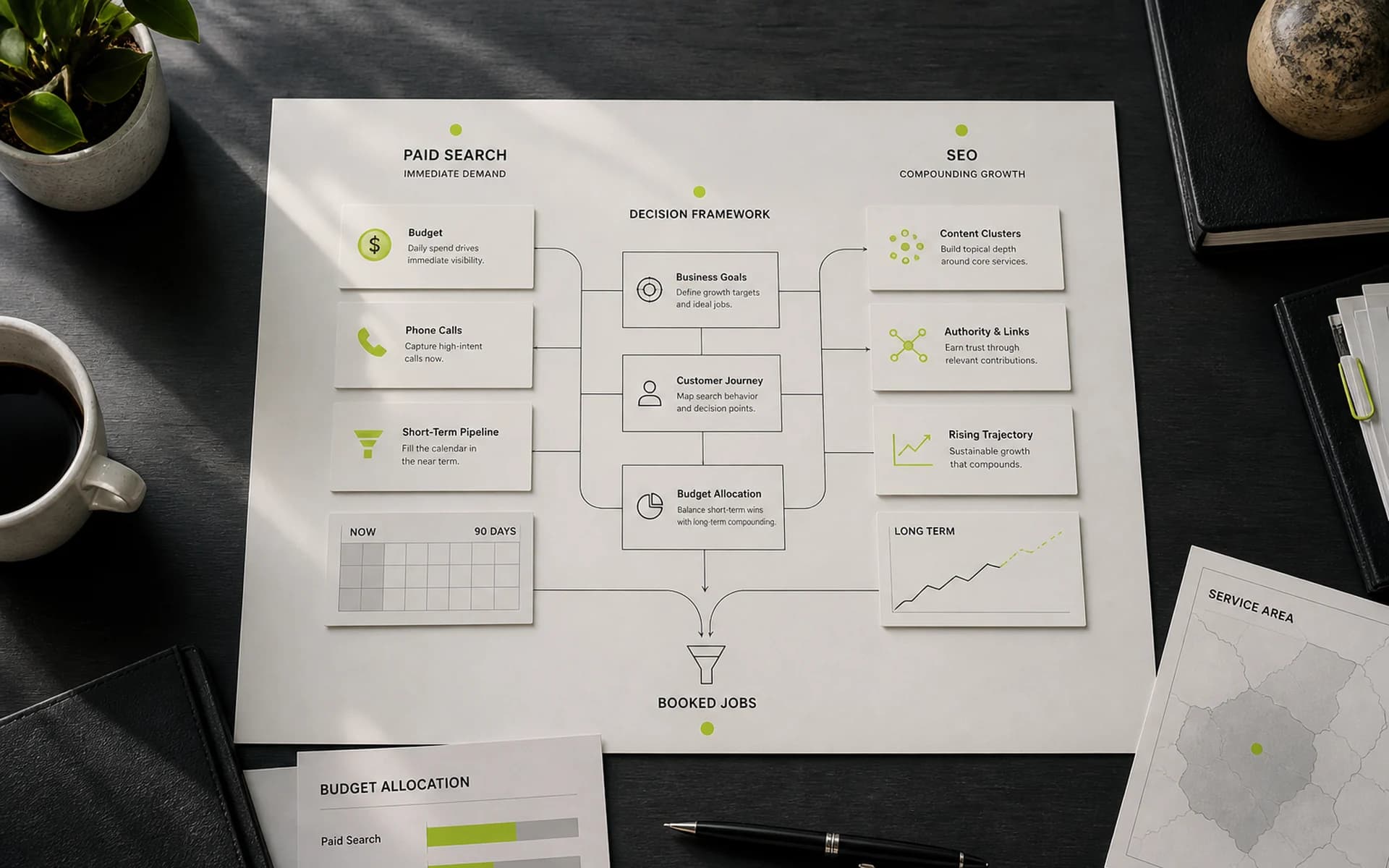
If pipeline is thin right now, paid search usually gets priority because it captures active demand immediately. Google Ads can show results within days — useful when cash flow and calendar cannot wait.
If revenue is stable and you need lower blended acquisition cost over time, SEO becomes a strategic growth lever. Long-term, SEO delivers roughly 748% ROI versus roughly 36% for PPC — about $7.48 earned per $1 invested in SEO over time, versus a much thinner long-term return on paid spend alone. Local SEO specifically averages around 700% ROI with a 6–12 month payoff window, while SEO overall typically takes 6–18 months to fully take hold.
That is the real tradeoff: speed now versus compounding value later. For paced paid ramps once demand is flowing, use paid traffic scaling without eroding margins. For the SEO side of local demand, start with how local SEO drives more leads for service businesses.
Quick takeaways
- Thin pipeline → paid first (results in days); stable revenue → SEO as the compounding lever.
- Long-term ROI: ~748% SEO vs. ~36% PPC; local SEO ~700% with a 6–12 month window.
- SEO typically takes 6–18 months to fully take hold — sequence the investment, don’t freeze.
Assess offer clarity before scaling any channel
Neither channel performs well when offer-market fit is weak. Make sure your positioning, pricing language, and conversion path are clear before heavy spend.
Paid can test messaging quickly, and SEO can then scale winning narratives into evergreen content. If paid underperforms after spend rises, diagnose structure and intent before blaming “SEO vs Ads” — see why most Google Ads campaigns fail and how to fix them.
Quick takeaways
- Weak offer-market fit breaks both SEO and Google Ads.
- Use paid to test messaging; fold winners into evergreen SEO.
- Fix conversion clarity before scaling budget or content volume.
A practical allocation model for SMBs
For many service businesses, a 60/40 or 70/30 split between paid and SEO works in early growth phases. The exact split depends on lead velocity requirements.
The allocation should shift as economics improve. Organic/SEO-driven leads cost roughly $31 on average versus roughly $181 for PPC-driven leads — about 5.8× more leads per dollar once SEO is ramped. Lead quality differs too: SEO-sourced leads close at roughly 14.6%, compared with roughly 1.7% for outbound/paid-sourced leads in the same comparative data set. Those are mature-channel figures, not day-one numbers — which is why months 1–3 stay paid-heavy and later months rebalance.
Turn the model into a 90-day operating cadence with a 90-day local marketing sprint, and keep CPL discipline with a CPL reduction checklist for local lead campaigns.
- Months 1-3: prioritize paid for data and immediate leads
- Months 3-6: expand SEO pages based on paid keyword proof
- Months 6+: rebalance toward highest-margin channel mix
Quick takeaways
- Early growth often runs ~60/40 or 70/30 paid-to-SEO by velocity need.
- Ramped SEO CPL ~$31 vs. PPC ~$181 (~5.8× more leads per dollar); close rates ~14.6% vs. ~1.7%.
- Rebalance after proof — not before the conversion path is honest.
Track channels by contribution, not competition
SEO and paid should not be managed in silos. Buyers often touch both channels before converting.
Attribution reviews should include assisted conversions, branded search lift, and close-rate differences by first touch. When funnel stages are soft, tighten the shared conversion system with a high-converting lead funnel framework before declaring one channel the winner.
Quick takeaways
- Buyers often touch both SEO and Google Ads before converting.
- Measure assisted conversions, branded lift, and close rate by first touch.
- Share one conversion standard across channels — don’t silo credit.
Build a hybrid system when growth is the goal
Paid captures demand now. SEO lowers dependency risk later. Together they reduce volatility and improve lead quality consistency.
The highest-performing accounts treat both channels as one revenue engine with shared messaging and shared conversion standards. Operationalize the mix with Strategy & Consulting and keep browsing decision essays in Strategy & Growth.
Quick takeaways
- Paid = demand now; SEO = lower dependency and compounding later.
- Run both as one engine: shared messaging and conversion standards.
- Hybrid beats a permanent either/or when growth is the goal.
Frequently Asked Questions
Is SEO cheaper than Google Ads?
SEO can become more efficient long-term, but it still requires consistent investment in content, technical quality, and authority signals.
Can I pause Google Ads once SEO improves?
Sometimes, but many businesses keep paid active for priority services, high-margin offers, and competitive terms where organic coverage is volatile.
What if my budget is limited?
Start with a focused paid campaign and a narrow SEO footprint around your highest-value service. Expand only after quality data validates performance.
How much better is SEO’s ROI compared to Google Ads, really?
Over the long term, SEO delivers roughly 748% ROI versus roughly 36% for PPC — about $7.48 per $1 invested in SEO versus a much thinner long-term return on paid alone. Local SEO often averages around 700% ROI with a 6–12 month payoff window. Google Ads can show results within days; SEO typically takes 6–18 months to fully take hold. Use paid for speed and SEO for compounding — not as a permanent either/or.
Which channel produces cheaper, higher-quality leads?
In comparative data, organic/SEO-driven leads average about $31 cost per lead versus about $181 for PPC-driven leads — roughly 5.8× more leads per dollar once SEO is ramped. SEO-sourced leads close at about 14.6% versus about 1.7% for outbound/paid-sourced leads in the same set. Treat those as mature-channel figures, not day-one results: early months often need paid for velocity while SEO compounds.
Related Resources
Need a channel‑mix plan you can execute?
We build practical SEO + paid roadmaps tied to lead goals and operating capacity.

Get your growth roadmap