
Cabarrus demand disappears inside a Charlotte metro radius
Oversized Charlotte geo packages buy edge-of-metro inquiries that look local on a map while Concord- and Cabarrus-named intent never gets its own bid, offer, or landing clarity.
CONCORD DIGITAL MARKETING
Built for Concord operators competing on the Cabarrus / I-85 demand corridor—where city intent, route economics, Maps honesty, and qualified booking matter more than buying an oversized Charlotte metro radius.

Cabarrus demand corridor
Concord sits on an I-85 / Cabarrus intent path. Treat Charlotte-edge, Harrisburg, Concord, and Kannapolis as distinct planning nodes—not one undifferentiated metro bid. These labels are service-area references, not FuelLabs offices.
Local realities
Concord service businesses rarely stall because Cabarrus demand disappears. They stall when Concord, Harrisburg, and Kannapolis intent gets bundled into a generic Charlotte radius—so Maps trust dilutes, crew travel economics hide inside blended CPL, and reporting celebrates metro volume while bookable corridor work stays flat.
Oversized Charlotte geo packages buy edge-of-metro inquiries that look local on a map while Concord- and Cabarrus-named intent never gets its own bid, offer, or landing clarity.
GBP and Local Pack performance suffer when service areas imply Concord, Harrisburg, Kannapolis, and Charlotte-edge work interchangeably—buyers shortlist providers who look honest about where they actually show up.
Charlotte-area landing templates ask for contact without proving Concord relevance, service match, or route eligibility—so corridor buyers bounce and low-fit metro shoppers fill the CRM.
Jobs that require long Charlotte-edge runs can report as “cheap leads” while margin and calendar capacity erode—because reporting never separates Concord core from drive-time waste.
Identical ads and pages for distinct Cabarrus nodes ignore ticket mix, dispatch density, and acceptance rates—so expansion decisions copy Charlotte suburb tactics instead of corridor economics.
Dashboards celebrate calls and forms while service-area acceptance, declined routes, and booked outcomes stay disconnected—so budgets scale metro volume instead of profitable Concord demand.
Services
FueLLabs connects the channels that decide whether Cabarrus demand becomes revenue—starting with Maps honesty, corridor geo discipline, conversion pages, qualification, and follow-up that protects expensive inquiries.
A Concord acquisition program should own Concord- and Cabarrus-named demand operators can actually route—then keep Charlotte metro radius packaging from swallowing corridor economics. For many service businesses that means connecting local SEO and reputation systems with Google Ads, conversion-focused websites, tracking, and lead response so I-85 corridor intent becomes qualified booked work—not undifferentiated Charlotte-edge volume.
Paid search structured for Concord call and estimate intent—with Cabarrus corridor geo controls instead of leaky Charlotte metro volume.
Explore Google Ads Management →Organic support for planned-demand services—so paid is not the only path to Concord and Cabarrus discovery.
Explore SEO for U.S. Businesses →Maps visibility, review velocity, and profile hygiene so high-intent Concord and Cabarrus searches meet trust signals aligned to routes crews can honor.
Explore Local SEO & Reputation →Conversion-focused estimate and booking paths built for mobile buyers comparing Concord-area providers—not generic Charlotte citywide templates.
Explore Website Design & Landing Pages →Corridor-aware lead response for forms and missed calls—so qualified Concord inquiries get a structured first reply before they cool off.
Explore Lead Response Automation →Prioritize corridor mix, Charlotte-radius leakage controls, and reputation readiness before widening Concord budget.
Explore Strategy & U.S. Market Consulting →Also available
Corridor markets punish blended metro stacks. Treat this mix as a planning lens—not a promise that every Cabarrus community launches on day one, and not a claim that FueLLabs operates a Concord office.
Categories, reviews, photos, and service lists still decide who earns a call when Cabarrus buyers compare providers. Keep Maps coverage aligned to the routes crews honor—without stuffing Harrisburg, Kannapolis, and Charlotte-edge names into thin doorway pages.
Campaigns should capture high-intent Concord and approved Cabarrus queries when calendars can absorb them—then use geo and query controls when oversized Charlotte metro radii pull drive-time waste that looks “local” on a metro map but fails route economics.
Estimate and booking flows need Concord / Cabarrus context, service clarity, and enough qualification cues that sales time goes to jobs crews can profitably serve—not every click from a generic Charlotte-area campaign.
Call, form, and CRM stages should show which service areas produce accepted jobs—not blended Charlotte-metro form volume. Structured response protects expensive corridor inquiries once geo is tightened.
Industries
Framed for operators whose growth depends on qualified Concord and Cabarrus inquiries—not brand campaigns for national retail. Categories describe demand patterns, not claims of local office coverage or invented Concord client outcomes.
Repair and comfort searches where Concord clarity and route economics protect booked jobs when Charlotte-edge bidding is loud.
View HVAC marketing →Call-driven demand that needs fast landing paths and qualification against low-fit metro traffic.
View Plumbing marketing →High-intent service calls that reward tight ad/page match, Maps locality, and reliable follow-up.
View Electrical marketing →Estimate-led inquiries where proof, timeline clarity, and service-area honesty matter as much as volume.
View Roofing marketing →Longer consideration cycles with landing pages that move buyers toward booked consultations inside real coverage.
View Remodeling marketing →Route and subscription models that need clear Concord / Cabarrus messaging and booking friction reduction.
View Cleaning marketing →Move-date demand where clear coverage claims, offers, and fast response protect booked jobs.
View Moving marketing →Dispatch-driven service calls where tracking and response speed protect booked corridor jobs.
View Appliance repair marketing →Appointment funnels where trust, offer clarity, and booking paths decide who gets scheduled.
View Med spa / beauty marketing →Appointment acquisition patterns for dental practices—category guidance, not Concord-specific client claims.
View Dental marketing →These briefs describe where Cabarrus corridor discipline and route economics usually matter first. They are planning lenses for categories—not claims that FueLLabs has Concord clients in every vertical or operates from a local storefront.
High-intent service searches reward complete GBP service lists, review velocity, and landing paths that match what crews actually do inside Concord and approved Cabarrus zones. Category framing lives on our HVAC marketing, plumbing marketing, and electrical marketing pages. Home-service category pages describe demand patterns—not invented Concord contractor outcomes.
Qualification and proof matter as much as volume when buyers compare multiple Carolinas providers. Ad groups and pages should filter for project fit and service-area honesty while reputation supports research-stage searches. Start with our roofing marketing and remodeling marketing guides when longer consideration cycles dominate demand.
Route and dispatch models need clearer Concord / Cabarrus messaging, simpler booking paths, and follow-up that protects margins when Charlotte-edge demand looks nearby but burns travel time. See our cleaning marketing page, moving marketing page, and appliance repair marketing page for category starting points.
Appointment-driven brands need offer clarity, trust on the first visit, and booking paths that match Concord-area discovery—without treating Charlotte metro packaging as automatic patient fit. Our med spa marketing guide and dental marketing guide outline appointment acquisition patterns. Published Charlotte dental SEO work is related Carolinas organic example evidence—not Concord client proof.
Local context
Concord is a Cabarrus / I-85 acquisition market for service businesses—not simply “northeast Charlotte.” Growth usually depends on connecting corridor geo honesty, Maps trust, high-intent paid capture, conversion-focused pages, lead qualification, tracking, and CRM follow-up—not launching one channel inside an oversized Charlotte radius.
We collaborate remotely with operators whose crews and calendars already define a real Concord map. Messaging, geo targets, and landing paths should match that map without thin Harrisburg/Kannapolis doorway pages or unsupported walk-in office claims.
Programs treat measurement and response speed as gates before scale: service-area acceptance, qualified calls, and booked outcomes guide where Cabarrus coverage expands next.
Buyers searching Concord, Harrisburg, Kannapolis, or nearby Cabarrus intent often compare providers who also advertise Charlotte. Campaigns, GBP settings, and landing pages should assume corridor comparison and route economics—not one permanent oversized metro bid.
Concord-named commercial demand should stay visible when Charlotte-edge or metro-wide modifiers are broader than the jobs crews can book profitably. Treat Cabarrus corridor planning as city-plus-qualified-nodes—not automatic coverage of every nearby name.
Harrisburg and Kannapolis can be profitable planning references when dispatch, ticket size, and acceptance rates support them. Midland, Mount Pleasant, and Northeast Charlotte references should stay secondary until crews can honor the claim without diluting Concord core work.
Is this a Concord-relevant service business for my location? Is my address inside a route you actually serve? Is the service available for my job type? Should I call or request a quote? What happens after I submit?
Service needed, Concord / Cabarrus location where useful, residential or commercial context, urgency versus planned timing, and call versus quote preference support routing. Do not force customers to decode every Charlotte suburb—and do not claim automatic coverage across an oversized Charlotte radius.
Confirm receipt, recover missed calls, schedule bookings or quote steps, tag Concord-fit versus Charlotte-radius spillover, stop irrelevant automation, and keep source attribution. Optimize toward accepted corridor jobs—not every metro form. Do not promise universal response times or booking guarantees.
Process
A practical sequence focused on corridor honesty, Charlotte-radius leakage, Maps trust, conversion, tracking, and response—before adding complexity.
Review Concord core routes, Cabarrus nodes claimed in ads/GBP, Charlotte metro packaging, offer clarity, landing friction, tracking gaps, and follow-up speed.
Stabilize Maps clarity, geo-controlled paid capture, landing conversion, route filters, or response routing first—whichever wastes the most qualified Concord demand.
Align message match, local visibility, and lead routing so inquiries can be measured as booked-work outcomes by service area.
Widen Harrisburg, Kannapolis, or secondary references only where qualified cost, service-area acceptance, and response capacity remain acceptable.
Sequence matters when Cabarrus demand and Charlotte radius blur coexist. This roadmap is a planning model—not a guaranteed timeline or outcome.
Clarify real Concord core routes, which Cabarrus nodes ads or GBP currently claim, Charlotte metro radius leakage, Maps coverage honesty, landing friction, and whether travel economics or weak source-to-booked tracking is the first bottleneck.
Tighten paid geo and negatives for oversized Charlotte packaging, align GBP and local pages to Concord-honest coverage, improve conversion paths for corridor intent, and connect call/form routing so inquiries get a structured first response with service-area tagging.
Iterate using service-area acceptance rate, qualified cost, and booked work signals—then add Harrisburg, Kannapolis, or secondary references only where route economics, Maps trust, and response capacity hold.
Measurement
Reporting categories we prioritize for Cabarrus corridor systems—these describe scope, not guaranteed results.
Tracked Google Business Profile actions tied to Concord and approved Cabarrus discovery.
Tracked phone conversations tied to campaign, keyword, or page source.
Estimate and contact submissions with spam filtering where practical.
Scheduled work marked as outcomes—not raw lead volume alone.
How often Concord- and Cabarrus-tagged inquiries are accepted into dispatch versus declined for route or fit reasons.
Spend divided by leads that meet your acceptance rules—not cost per any Charlotte-radius form.
Time from inquiry to first meaningful response across business hours and after hours.
Service area
We partner with service businesses whose dispatch maps center on Concord and selected Cabarrus communities—aligned to the routes you can honor, not a generic Charlotte metro claim.
Service-area relevance belongs in geo targets, GBP settings, and landing clarity. We do not recommend thin, duplicated pages for every community name, and we do not claim a Concord storefront or walk-in office.
Many Concord operators serve the city plus selected Cabarrus corridor communities in a single brand and dispatch map. Marketing should reflect that radius in ads, listings, and landing copy—without doorway pages that dilute relevance. Related Carolinas market guides include Charlotte and Raleigh. Fort Mill is a related border-growth reference when published. Browse the full Explore all markets hub for every published city guide.
Marketing geography, proof, and service claims should match the business’s actual operational position. FueLLabs does not claim a physical Concord office, and this page is not a Charlotte metro, Harrisburg, Kannapolis, or all-Cabarrus County coverage claim by default.
FAQ
Yes. We collaborate remotely with U.S. service businesses whose growth depends on local acquisition—including operators serving Concord and selected Cabarrus corridor communities. This page explains how we approach Cabarrus demand, Charlotte-radius separation, and route economics; engagements are scoped around your service map and bottlenecks. We do not claim a Concord office.
Resources
Guides on local reputation, paid search discipline, landing conversion, tracking, and lead quality for Cabarrus corridor markets.
These articles expand on local visibility, paid search discipline, landing conversion, tracking, and lead-quality systems—useful reading before a strategy call. For published related Carolinas organic work (Charlotte dental SEO—not Concord home-service proof), see our Charlotte dental SEO case study.

A practical framework for separating Concord and Cabarrus demand from an oversized Charlotte radius — so spend follows service fit, not metro folklore.
Read strategy & growth guide →
A practical local SEO playbook for service brands that want qualified calls, not vanity traffic.
Read local seo & reputation guide →
The biggest Google Ads mistakes we see in audits and the operating model that fixes wasted spend.
Read google ads guide →
Why most paid campaigns underperform until landing pages match buyer intent and reduce friction.
Read website & cro guide →
Design quality matters, but conversion architecture determines whether your site actually drives revenue.
Read website & cro guide →
Without clean tracking, optimization becomes guesswork and growth decisions get expensive fast.
Read strategy & growth guide →
How to move from campaign experiments to a repeatable lead engine your team can scale confidently.
Read strategy & growth guide →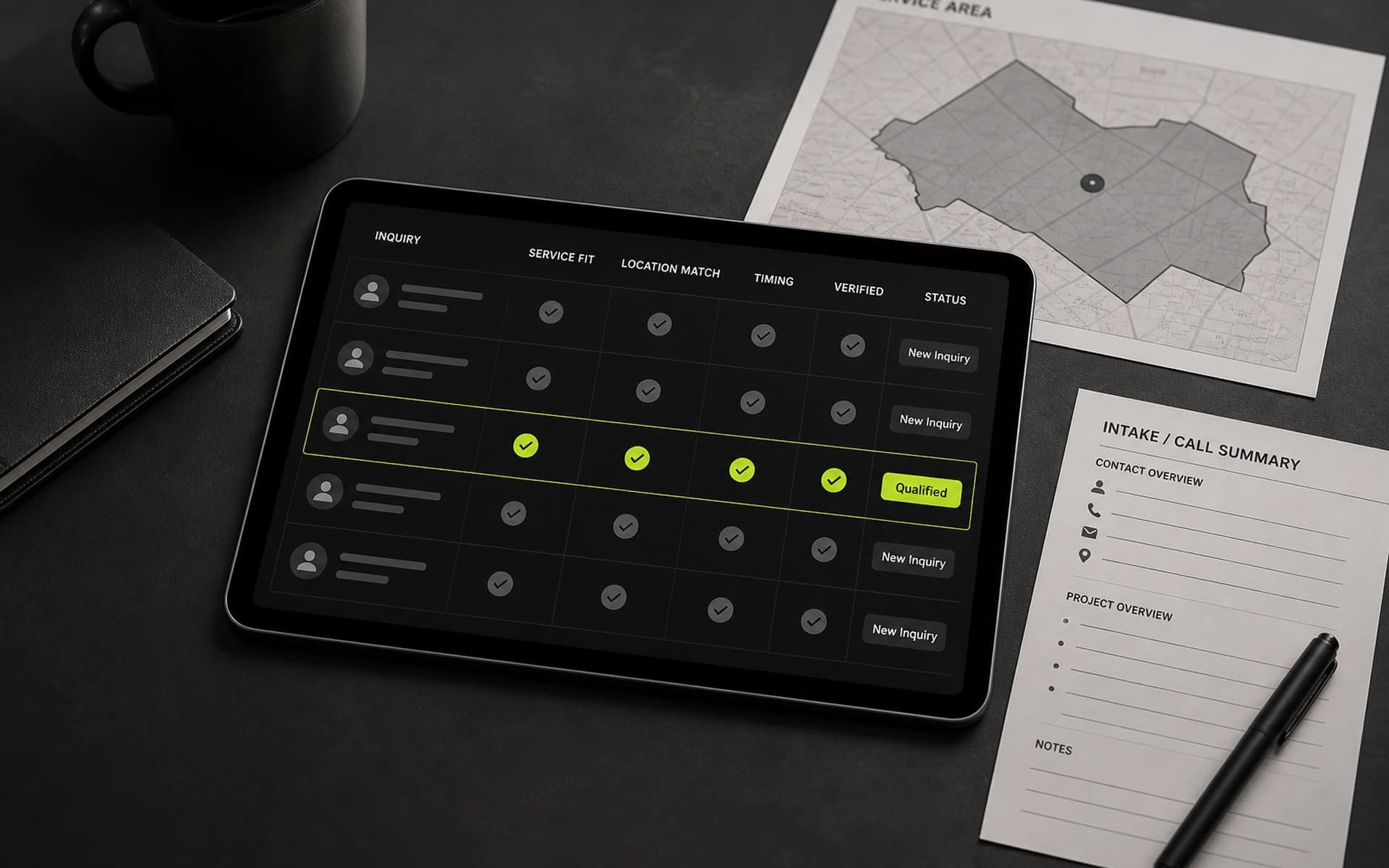
More leads do not matter if your sales team cannot close them. Here is how to engineer quality upstream.
Read strategy & growth guide →Evaluate whether Concord identity is clear, whether ads and pages stay honest about Cabarrus route fit, whether Charlotte metro packaging is leaking budget, whether Maps coverage matches real dispatch, whether tracking shows service-area acceptance, and whether follow-up protects booked-job opportunities—before you scale spend into a wider radius.