
EcoHub Logistics · Case Study
EcoHub Logistics Website & Lead Generation Case Study
A clearer route from search intent to qualified inquiry.
FueLLabs connected EcoHub’s website experience, conversion paths, and paid acquisition into one lead-generation system built for quote-ready car shipping demand.
- 66%Lower cost per lead$112 → $38
- 3.4×Monthly lead volume10 → 34 leads / month
- 2.1% → 6.8%Conversion rate+4.7 percentage points
Reported project results from the connected website and acquisition system.

Project snapshot
- Client
- EcoHub Logistics
- Industry
- Car shipping / auto transport
- Market
- United States (Orlando, FL base)
- Services
- Website development · Google Ads · Conversion optimization
- Primary objective
- Lower CPL while scaling higher-intent quote volume
- Build engagement
- 6 weeks
Context
Business context
EcoHub Logistics operates in car shipping and auto transport—helping customers move vehicles through a quote-driven acquisition journey.
In this category, buyers arrive with route and timing intent. Trust, clarity, and a fast path to a quote matter as much as traffic volume. The website is not a brochure; it is part of the acquisition system that turns search demand into sales-ready inquiries.
Baseline
The starting point
Before the rebuild, EcoHub’s acquisition path was expensive relative to quote volume, and the site was not structured as a conversion-first offer for high-intent car shipping searches.
- Lead costs were high—reported in the roughly $95–$120 CPL range before the system work.
- Monthly quote volume was stuck around 8–12 leads.
- The existing site looked outdated and lacked a conversion-first offer.
- Traffic quality skewed toward low-intent visits poorly aligned with quote-ready buyers.
Diagnosis
Diagnostic findings
FueLLabs reviewed how message, intent, and conversion path lined up before rebuilding the system.
Intent mismatch
Paid and organic demand needed clearer separation between quote-ready car shipping searches and lower-intent browsing.
Offer and CTA clarity
The site did not present a single, fast primary action oriented around requesting a shipping quote.
Trust and service presentation
Proof and service clarity needed to sit closer to the decision to inquire—not buried below generic content.
Measurement continuity
Call and form tracking needed to connect acquisition spend to real quote outcomes so optimization could follow quality, not vanity volume.
System
Growth-system overview
The engagement treated website and paid acquisition as one route—from search intent to a qualified inquiry.
Search intent
High-intent car shipping and route-related demand
Matched experience
Quote-first landing structure and message continuity
Quote request
Faster primary CTA and clearer offer
Lead capture
Call and form tracking on the conversion path
Sales follow-up
Quote-ready inquiries for the sales team
Website
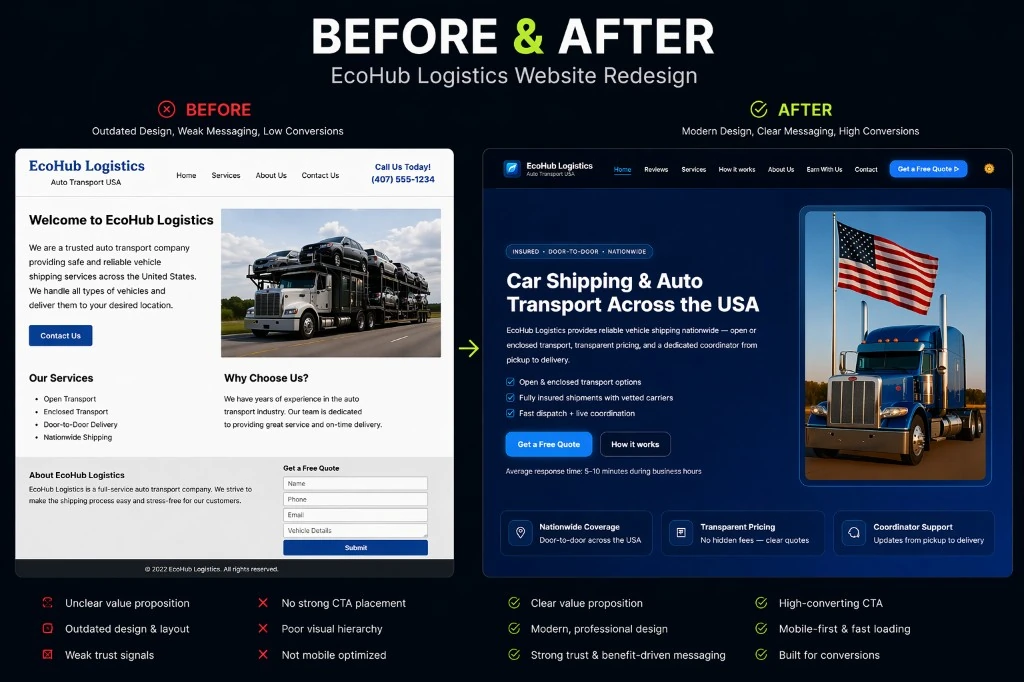
Website conversion system
The website rebuild focused on quote-ready car shipping intent: clearer value proposition, trust near the decision point, and a conversion path that matched what ads and searches promised.
High-intent quote landing structure
Dedicated structure around specific car shipping quote intent instead of a generic brochure layout.
Offer and conversion copy
Rewritten messaging so visitors could understand the offer and take one primary next step.
Trust near the CTA
Trust signals placed to support inquiry decisions rather than decorate the page.
Mobile-ready conversion path
A path designed for the way shipping quotes are often started—on the phone, under time pressure.
Acquisition
Paid acquisition system
Google Ads was rebuilt alongside the site so searchers landed on experiences that matched intent—and so spend could be judged by quote outcomes, not clicks alone.
- Campaign structure segmented around higher-intent search themes relevant to car shipping quotes.
- Low-intent search waste reduced so budget could follow routes and queries more likely to convert.
- Call and form tracking connected the click path to inquiry outcomes for ongoing optimization.
- Message continuity between ads, landing experience, and the quote CTA reduced friction after the click.
Campaign-level keyword lists, budgets, and bidding tactics are not published here. This section describes the role of paid acquisition in the connected system, based on the project record currently available.
Flow
Lead journey
For EcoHub, a useful lead is a quote-ready inquiry—not every visit. The system aligned source, intent, page experience, and capture.
| Stage | How it worked in this engagement |
|---|---|
| Traffic source | High-intent search demand via rebuilt Google Ads structure |
| User intent | Vehicle shipping quote interest with route and timing context |
| Page experience | Conversion-first landing path matched to that intent |
| Quote action | Clear primary CTA for call or form inquiry |
| Follow-up | Sales receives quote-oriented leads at a lower acquisition cost |
Comparison
Before and after
Reported project results for the connected website and acquisition system (Group A metrics for this case).
Before
- CPL$112
- Monthly leads10
- Conversion rate2.1%
After
- CPL$38
- Monthly leads34
- Conversion rate6.8%
Outcomes
Results observed during the engagement
Figures below are reported project results from the EcoHub website and lead-generation engagement currently published for this case. Documentary exports (Ads / analytics screenshots) can be attached as follow-up evidence.
Cost per lead
$112$38
66% lower (−$74)
Acquisition cost per lead fell from $112 to $38 across the connected system.
Monthly lead volume
1034
3.4× volume (+24 leads)
Monthly leads increased from 10 to 34—3.4× the baseline volume.
Conversion rate
2.1%6.8%
+4.7 pts (~224% relative)
Conversion rate moved from 2.1% to 6.8% as traffic reached a clearer quote path.
Results were observed across the connected website and acquisition system—not attributed to a single isolated page change.
Contribution
What drove the change
The lift reflects contribution from several connected pieces—not a claim that one lever alone produced every outcome.
Intent alignment
Search themes and landing experiences were pointed at quote-ready car shipping demand.
Clearer conversion path
A faster primary CTA and conversion-first structure reduced friction between click and inquiry.
Acquisition optimization
Paid structure and waste reduction helped spend follow higher-quality demand.
Measurement for iteration
Call and form tracking supported optimizing toward real quote outcomes.
Takeaways
Case-specific lessons
In auto transport, the website is part of the acquisition system—not a separate brand brochure.
CPL and lead volume must be read together; cheaper leads that are not quote-ready do not help sales.
Message continuity between search intent, landing experience, and CTA protects paid spend after the click.
Tracking calls and forms is required before optimization can follow quality instead of vanity metrics.
Related capabilities
Explore related FueLLabs services
- Website design & landing pagesConversion-focused site and landing experiences for service businesses.
- Google AdsPaid search structured around qualified inquiries and measurable outcomes.
- Lead response automationFaster follow-up systems so inquiries do not stall after capture.
- Car shipping marketingIndustry framing for quote quality and route-aware acquisition.



Where is your lead journey losing opportunities?
We can review your offer, landing experience, and acquisition path—then map a clearer route from intent to qualified inquiry.